Tips on how to Enhance Your Intestine Well being and Microbiome
You can view the original post here
Reviewed by Gabrielle Fundaro, PhD, CISSN, CHC
“I can’t go out tonight, I’m… busy.”
If you happen to battle with intestine well being issues, this line is usually code for one—or all—of the next:
“I have to stay close to the bathroom.”
“I can’t wear real pants right now.”
“My farts might kill you.”
Digestive signs like gasoline, bloating, indigestion, and bathroom troubles are frequent—and will be extraordinarily disruptive (and never simply to your social life).
However when you’re regularly tormented by these points, all you actually need to know is:
What's going to truly assist my stomach really feel higher??!
Loads, truly.
Within the following story, you’ll uncover:
- How stress, train, and lots of different elements have an effect on your intestine well being and microbiome
- Tips on how to restore intestine well being after taking antibiotics
- Whether or not you’re the sort of one who might profit from further fiber
- If fermented meals stay as much as their hype
- Which dietary supplements would possibly assist signs like constipation, heartburn, and extra, in response to analysis
Most essential, you’ll discover 5 evidence-based, cost-effective methods to enhance intestine and microbiome well being total.
Over 150,000 well being & health professionals licensed
Save as much as 30% on the business's high vitamin schooling program
Get a deeper understanding of vitamin, the authority to teach it, and the power to show that data right into a thriving teaching follow.
First, what the heck is the microbiome?
This group of microorganisms (micro organism, fungi, and and their genetic materials) lives in your pores and skin, in your mouth, in your lungs, and all through your digestive tract.
Researchers estimate that between 10–100 trillion microorganisms stay in your GI tract alone.
Which suggests: Your physique is mainly a human-shaped pile of micro organism.
Your microbiome is as distinctive as your fingerprint.
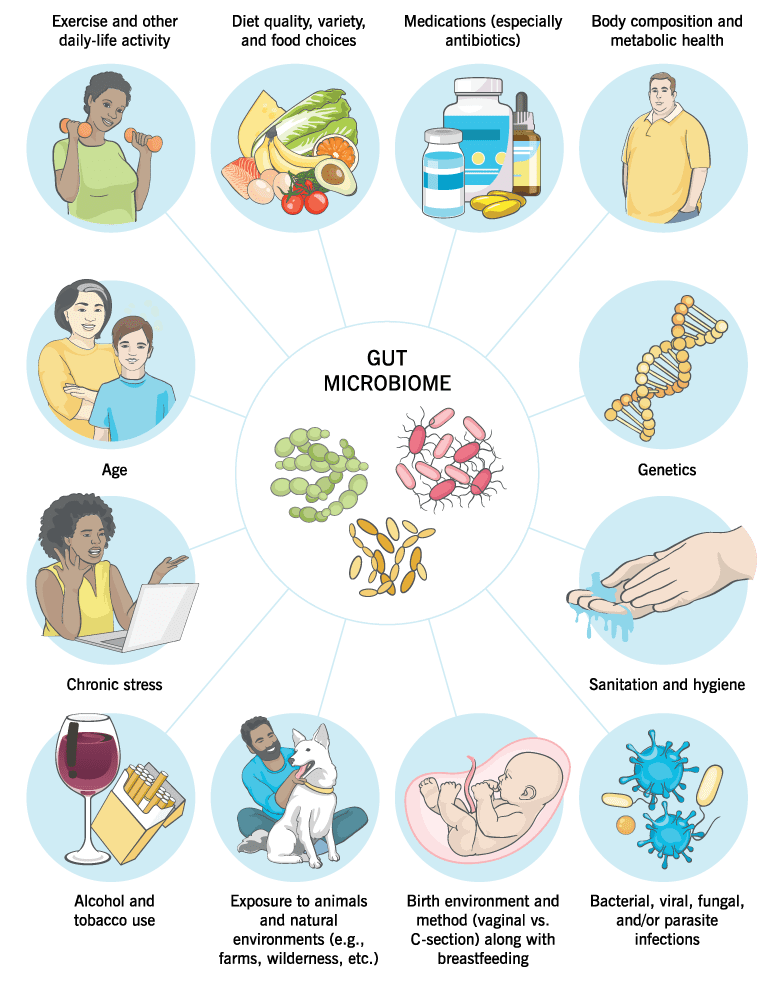
The quantity and proportions (aka. variety) of micro organism and fungi may also change all through your life, relying on quite a lot of influences, because the picture beneath reveals.
Many of those critters are like barnacles on a whale. They hitch alongside for the journey for free of charge to you.
Many others are useful, serving to to maintain your pores and skin, gums, and GI tract wholesome. These pleasant intestine micro organism assist:
- Produce small quantities of vitamins, like nutritional vitamins B and Ok
- Ferment fiber and resistant starch which create short-chain fatty acids (SCFAs) that assist regulate your immune system, urge for food, and stress response1 2
- Hold the system transferring (a.ok.a. pooping recurrently) by bulking up stool and growing intestine motility
- Regulate irritation and the immune system
Although there’s nonetheless so much researchers don’t know in regards to the microbiome, they do know this:
Your intestine micro organism play a serious function in your well being and wellbeing.
With that in thoughts, listed below are 5 sensible, science-based methods to help these useful, hard-working little pals—and in flip, promote good digestive perform, and total well being.
Tips on how to help intestine well being
These methods may also help you enhance bacterial variety and digestive perform, in addition to cut back the danger of illness.
1. Chew your meals.
Whenever you slowly and completely chew meals, you break your meal down into smaller, extra digestible bits. The smaller items additionally improve the quantity of floor space for digestive enzymes to work on and assist chemical digestion.
Then again, once you eat rapidly, you are inclined to gulp down massive chunks of meals—and certain numerous air—which may result in indigestion and bloating. Plus, these enzymes have a tougher time digesting bigger items of meals.
If attainable, give your self somewhat further time at meals.
Take note of your meals (a minimum of intermittently), pause to breathe each every now and then, and put your enamel to work, aiming for the feel of applesauce earlier than every gulp.
2. Embrace many various kinds of minimally-processed plant-based meals.
Fruits, greens, complete grains, starchy tubers, beans, and different minimally-processed plant meals do two helpful issues in your intestine:
- They feed intestine micro organism. When micro organism chows down on fiber, it multiplies and contributes to short-chain fatty acid manufacturing in addition to bacterial variety.
- They supply micro organism with useful phytochemicals (like polyphenols) that may be reworked into antioxidant and antiinflammatory compounds.3 4
(Need assist selecting minimally-processed meals? Take a look at: ‘What should I eat?!’ Our 3-step information for selecting one of the best meals in your physique)
In the meantime, when you eat largely highly-processed meals (and never a variety of minimally-processed meals) the range and exercise of your microbiome reduces.5
In rat research, this has been proven to skew the general surroundings towards micro organism which will improve irritation and illness danger, starvation and urge for food, and vulnerability to the consequences of stress, like temper or hormonal imbalances.6
(To be clear, we’re not suggesting you narrow processed meals out altogether. Within the context of a nutritious diet, indulging would possibly truly be good for you. See: Tips on how to eat junk meals: A information for conflicted people.)
Are fermented meals good for the intestine?
Kombucha. Natto. Sauerkraut. Kimchi. Yogurt.
A couple of decade in the past, meals and beverage merchandise with “live bacterial cultures”—and claims to enhance digestion—exploded onto the market.
(After all, many of those meals have existed for hundreds of years as meals staples in sure cultures. As many Jap Europeans will let you know: “Kvass is old news!”)
However do they work?
We’ll lower to the chase:
Solely fermented dairy (particularly, kefir) is supported by high-quality proof. Even then, its advantages appear to use extra to cardiometabolic well being than to digestive well being.7
A recent study that’s gotten a lot of buzz implies that a vary of different fermented meals might improve microbiome variety, however extra analysis is required to find out whether or not that is as a result of ferments themselves or just the inclusion of latest minimally-processed meals.
So, whereas lacto-fermented veggies and sourdough are scrumptious and may contribute to a diverse, nutrient-dense weight loss plan, there’s no assure (and no indeniable proof, so far) they’ll enhance your digestion or elimination.
3. Add a fiber complement. (Possibly.)
This would possibly come as a shock:
Not everybody advantages from extra fiber.
[Flings cardboard-like high-fiber cereal into the fire]
If you happen to devour a weight loss plan wealthy in minimally-processed meals, your weight loss plan is already naturally wealthy in fiber. And including much more of the stuff might not transfer the digestive needle a lot, if in any respect.
On high of that, some persons are delicate to compounds known as FODMAPs—which stands for fermentable oligosaccharides, disaccharides, monosaccharides, and polyols—present in particular fiber-rich meals. After they eat these meals, they’ll expertise gasoline, bloating, and free stools.
The above caveats apart, there are just a few eventualities the place a fiber complement will be a good suggestion:
▶ You battle to eat minimally-processed meals.
This is perhaps as a result of you possibly can’t readily entry them, or as a result of you possibly can’t tolerate the style.
Think about supplementing with a mixture of soluble and insoluble fiber. Additionally, experiment with including complete meals like fruits, greens, complete grains, and legumes for extra fiber and an total vitamin enhance.
▶ You eat largely minimally-processed meals, however you keep away from carbs.
In different phrases, you largely eat non-starchy greens, animal proteins, and wholesome fat.
In case your intestine capabilities effectively, you doubtless don’t must make any modifications.
Nonetheless, in case your poops are rare, laborious to move, or very small, contemplate including extra soluble fiber, both by meals like beans, lentils, oats, or candy potatoes (when you’re prepared to change your macro break up), or by a complement like psyllium powder.
(For TMI on precisely what a super poop ought to appear to be, take a look at: Are your consuming and life-style habits REALLY working? Simply ask your poo)
▶ Regardless of consuming a full vary of minimally-processed meals, you continue to battle with constipation.
Though psyllium (a soluble fiber) would possibly assist with constipation, it could possibly truly worsen different issues like diarrhea, gasoline, and bloating. Earlier than including it, speak to your physician or healthcare practitioner to rule out meals allergic reactions, intolerances, or different causes of digestive misery.
(An elimination weight loss plan will be an effective way to evaluate when you’re reacting negatively to sure meals. Right here’s a primer to get you began: Elimination diets: How and why to do them.)
Crash course: Soluble vs. Insoluble Fiber
If you happen to’re desirous about altering your fiber consumption (perhaps since you’ve heard it would assist a digestive subject) it could possibly assist to know the distinction between the 2 sorts of fiber.
▶ Soluble fiber absorbs water. This creates a gel that softens stool. Soluble fiber additionally feeds useful intestine micro organism.8
Meals like complete grains, beans, legumes, and psyllium are wealthy in soluble fiber.
▶ Insoluble fiber doesn’t dissolve in water. It provides bulk or weight to stool, making it simpler and infrequently sooner to move. As a result of it helps enhance toilet regularity, insoluble fiber reduces the danger of GI signs9 and bowel illnesses.10
Many non-starchy greens and wheat bran are good sources of insoluble fiber.
Observe: If you happen to’re at the moment consuming a really low fiber weight loss plan and begin incorporating extra fiber—both by complete meals or dietary supplements—generally there’s an adjustment interval.
For a few weeks, you would possibly discover further gurgling, gasoline, and perhaps modifications in bowel exercise. If it turns into too uncomfortable, cut back for a time period. Reintroduce extra reasonably once you’re prepared.
Ultimately, most individuals alter and discover their urge for food, digestion, and total well being significantly profit from enough fiber.
4. If it's a must to take antibiotics, add some good micro organism again in.
Antibiotics will be life-saving. And sooner or later, nearly all of us must take them.
(Observe: Solely a physician can resolve when antibiotics are—or aren’t—acceptable.)
Nonetheless, antibiotics are related to much less microbial variety within the intestine, in addition to a rise of “bad” micro organism (suppose: C. difficile, Salmonella, and antibiotic-resistant Enterococcus).11
In wholesome folks, intestine micro organism ranges get well fairly effectively—however not completely—after taking antibiotics.
In a single examine, folks recovered to shut to their pre-antibiotic baseline inside six weeks, however had been nonetheless lacking a number of strains of micro organism that had been current earlier than the antibiotics six months later.12
In some circumstances, probiotics—supplemental useful micro organism—may also help.
Particularly within the case of antibiotic-associated diarrhea, dietary supplements containing Lactobacillus rhamnosus GG and Saccharomyces boulardii appear to work effectively to forestall signs.13
Simply keep in mind not everybody responds to particular probiotics in the identical method.
Particular person response relies on the micro organism you have already got in your intestine, plus whether or not the supplemental micro organism takes up residence in your GI tract or simply passes by.
(To search out out when probiotics are most helpful, learn: Do probiotics actually work?)
5. Transfer.
Bodily exercise and cardiovascular health are related to extra microbial variety and extra short-chain fatty acids.14 15 16
(Recall: SCFAs do numerous good issues for the physique, from higher immunity, to raised tolerance to emphasize.)
Moreover, once you interact in mild-moderate train, you stimulate the parasympathetic (“rest and digest”) nervous system.
Not solely does this have an total stress-free impact on the physique and thoughts, nevertheless it additionally encourages motion (peristalsis) within the digestive tract, aiding each digestion and elimination.
(In case you’re curious, pooping well-formed, easy-to-pass stools anyplace from 3 times a day to each different day is an indication of excellent elimination.)
Additional credit score: Dietary supplements that may assist with indigestion, gasoline, and pooping.
Sadly, uncomfortable digestive signs generally nonetheless occur to individuals who do all the things steered on this article.
When you've got gentle indigestion, gasoline, or pooping issues—and may’t discover any apparent culprits (or options)—dietary supplements is perhaps the additional nudge to get digestion and elimination again on monitor.
Right here’s an inventory of frequent signs, and the dietary supplements that may assist:
| Symptom | Proof-based complement |
|---|---|
| Extreme gasoline / bloating | Particular digestive enzymes17 18 Choose enzymes may also help when you get signs after consuming sure meals, resembling alpha-galactosidase for beans and legumes, or lactase for dairy. Enteric-coated peppermint oil19 Whereas peppermint oil can cut back ache, gasoline, and bloating, it could possibly truly make acid reflux disease worse, if that’s a symptom you already expertise. |
| Heartburn | Ginger, tea or capsules20 21 22 Ginger additionally helps with nausea. |
| Constipation | Magnesium citrate23 24 Magnesium is secure for long-term use, in contrast to most laxatives, that are habit-forming and aren’t good options for continual constipation. |
| Diarrhea | Electrolytes & fluids25 Often an indication of an acute an infection, diarrhea is the physique’s method of clearing out undesirable pathogens. For that cause, it’s usually finest to let it run its course. To scale back dehydration related to diarrhea, hydrate with water, sports activities drinks, or over-the-counter rehydration options. |
If any of the above signs are extreme or persist for various days, contact your physician.
For most individuals, the fundamentals can actually assist.
You is perhaps tempted to skip the above recommendation with a harrumphing:
“Blah blah blah, I KNOW this already! Isn’t there some more innovative, cutting edge protocol I can try??”
(Properly, perhaps. You might look into fecal transplantation. We’ll wait right here whilst you resolve that truly, you’ll attempt the essential weight loss plan and life-style modifications in any case.)
As a lot of our coaches and purchasers have skilled:
The problem isn’t figuring out what to do. It’s truly doing it, constantly.
Our recommendation?
Lean into consistency fairly than novelty.
As in, “How can I slow down a little more at meals, or be a little more intentional about my veggie consumption” as an alternative of “What’s the next trendy substance or protocol that promises to supercharge my microbiome?”
And when you want some motivation:
Modifications in microbiome profiles can occur even inside 24 hours of switching up your weight loss plan.26
So, wherever you’re ranging from, once you add some primary practices, your intestine micro organism might profit inside a brief time period.
(Practically) prompt gratification!
References
Click on right here to view the knowledge sources referenced on this article.
- Dalile, Boushra, Bram Vervliet, Gabriela Bergonzelli, Kristin Verbeke, and Lukas Van Oudenhove. 2020. “Colon-Delivered Short-Chain Fatty Acids Attenuate the Cortisol Response to Psychosocial Stress in Healthy Men: A Randomized, Placebo-Controlled Trial.” Neuropsychopharmacology: Official Publication of the American Faculty of Neuropsychopharmacology 45 (13): 2257–66.
- Wouw, Marcel van de, Marcus Boehme, Joshua M. Lyte, Niamh Wiley, Conall Pressure, Orla O’Sullivan, Gerard Clarke, Catherine Stanton, Timothy G. Dinan, and John F. Cryan. 2018. “Short-Chain Fatty Acids: Microbial Metabolites That Alleviate Stress-Induced Brain-Gut Axis Alterations.” The Journal of Physiology 596 (20): 4923–44.
- Edwards, C. A., J. Havlik, W. Cong, W. Mullen, T. Preston, D. J. Morrison, and E. Combet. 2017. “Polyphenols and Health: Interactions between Fibre, Plant Polyphenols and the Gut Microbiota.” Diet Bulletin / BNF 42 (4): 356–60.
- Moco, Sofia, François-Pierre J. Martin, and Serge Rezzi. 2012. “Metabolomics View on Gut Microbiome Modulation by Polyphenol-Rich Foods.” Journal of Proteome Analysis 11 (10): 4781–90.
- Heiman, Mark L., and Frank L. Greenway. 2016. “A Healthy Gastrointestinal Microbiome Is Dependent on Dietary Diversity.” Molecular Metabolism 5 (5): 317–20.
- Zinöcker, Marit Ok., and Inge A. Lindseth. 2018. “The Western Diet-Microbiome-Host Interaction and Its Role in Metabolic Disease.” Vitamins 10 (3).
- Dimidi, Eirini, Selina Rose Cox, Megan Rossi, and Kevin Whelan. 2019. “Fermented Foods: Definitions and Characteristics, Impact on the Gut Microbiota and Effects on Gastrointestinal Health and Disease.” Vitamins 11 (8).
- Anderson, James W., Pat Baird, Richard H. Davis Jr, Stefanie Ferreri, Mary Knudtson, Ashraf Koraym, Valerie Waters, and Christine L. Williams. 2009. “Health Benefits of Dietary Fiber.” Diet Critiques 67 (4): 188–205.
- Lambeau, Kellen V., and Johnson W. McRorie Jr. 2017. “Fiber Supplements and Clinically Proven Health Benefits: How to Recognize and Recommend an Effective Fiber Therapy.” Journal of the American Affiliation of Nurse Practitioners 29 (4): 216–23.
- Papandreou, Dimitrios, Zujaja Tul Noor, and Maitha Rashed. 2015. “The Role of Soluble, Insoluble Fibers and Their Bioactive Compounds in Cancer: A Mini Review.” Meals and Diet Sciences 06 (01): 1–11.
- Dudek-Wicher, Ruth Ok., Adam Junka, and Marzenna Bartoszewicz. 2018. “The Influence of Antibiotics and Dietary Components on Gut Microbiota.” Przeglad Gastroenterologiczny 13 (2): 85–92.
- Palleja, Albert, Kristian H. Mikkelsen, Sofia Ok. Forslund, Alireza Kashani, Kristine H. Allin, Trine Nielsen, Tue H. Hansen, et al. 2018. “Recovery of Gut Microbiota of Healthy Adults Following Antibiotic Exposure.” Nature Microbiology 3 (11): 1255–65.
- Blaabjerg, Sara, Daniel Maribo Artzi, and Rune Aabenhus. 2017. “Probiotics for the Prevention of Antibiotic-Associated Diarrhea in Outpatients-A Systematic Review and Meta-Analysis.” Antibiotics (Basel, Switzerland) 6 (4).
- Clarke, Siobhan F., Eileen F. Murphy, Orla O’Sullivan, Alice J. Lucey, Margaret Humphreys, Aileen Hogan, Paula Hayes, et al. 2014. “Exercise and Associated Dietary Extremes Impact on Gut Microbial Diversity.” Intestine 63 (12): 1913–20.
- Mailing, Lucy J., Jacob M. Allen, Thomas W. Buford, Christopher J. Fields, and Jeffrey A. Woods. 2019. “Exercise and the Gut Microbiome: A Review of the Evidence, Potential Mechanisms, and Implications for Human Health.” Train and Sport Sciences Critiques 47 (2): 75–85.
- Ortiz-Alvarez, Lourdes, Huiwen Xu, and Borja Martinez-Tellez. 2020. “Influence of Exercise on the Human Gut Microbiota of Healthy Adults: A Systematic Review.” Medical and Translational Gastroenterology 11 (2): e00126.
- Quinten, Thomas, Jean-Michel Philippart, Thomas De Beer, Stefaan Vervarcke, and Mieke Van Den Driessche. 2014. “Can the Supplementation of a Digestive Enzyme Complex Offer a Solution for Common Digestive Problems?” Archives of Public Well being = Archives Belges de Sante Publique 72 (1): 1–2.
- Majeed, Muhammed, Shaheen Majeed, Kalyanam Nagabhushanam, Sivakumar Arumugam, Anurag Pande, Mahesh Paschapur, and Furqan Ali. 2018. “Evaluation of the Safety and Efficacy of a Multienzyme Complex in Patients with Functional Dyspepsia: A Randomized, Double-Blind, Placebo-Controlled Study.” Journal of Medicinal Meals 21 (11): 1120–28.
- Alammar, N., L. Wang, B. Saberi, J. Nanavati, G. Holtmann, R. T. Shinohara, and G. E. Mullin. 2019. “The Impact of Peppermint Oil on the Irritable Bowel Syndrome: A Meta-Analysis of the Pooled Clinical Data.” BMC Complementary and Different Medication 19 (1): 21.
- Ebrahimzadeh Attari, Vahideh, Mohammad Hosein Somi, Mohammad Asghari Jafarabadi, Alireza Ostadrahimi, Seyed-Yaghob Moaddab, and Neda Lotfi. 2019. “The Gastro-Protective Effect of Ginger (Zingiber Officinale Roscoe) in Helicobacter Pylori Positive Functional Dyspepsia.” Superior Pharmaceutical Bulletin 9 (2): 321–24.
- Hu, Ming-Luen, Christophan Ok. Rayner, Keng-Liang Wu, Seng-Kee Chuah, Wei-Chen Tai, Yeh-Pin Chou, Yi-Chun Chiu, King-Wah Chiu, and Tsung-Hui Hu. 2011. “Effect of Ginger on Gastric Motility and Symptoms of Functional Dyspepsia.” World Journal of Gastroenterology: WJG 17 (1): 105–10.
- Giacosa, Attilio, Davide Guido, Mario Grassi, Antonella Riva, Paolo Morazzoni, Ezio Bombardelli, Simone Perna, Milena A. Faliva, and Mariangela Rondanelli. 2015. “The Effect of Ginger (Zingiber Officinalis) and Artichoke (Cynara Cardunculus) Extract Supplementation on Functional Dyspepsia: A Randomised, Double-Blind, and Placebo-Controlled Clinical Trial.” Proof-Primarily based Complementary and Different Medication: eCAM 2015 (April): 915087.
- Mori, Sumire, Toshihiko Tomita, Kazuki Fujimura, Haruki Asano, Tomohiro Ogawa, Takahisa Yamasaki, Takashi Kondo, et al. 2019. “A Randomized Double-Blind Placebo-Controlled Trial on the Effect of Magnesium Oxide in Patients With Chronic Constipation.” Journal of Neurogastroenterology and Motility 25 (4): 563–75.
- Dupont, Christophe, and Guillaume Hébert. 2020. “Magnesium Sulfate-Rich Natural Mineral Waters in the Treatment of Functional Constipation-A Review.” Vitamins 12 (7).
- Rao, S. S. C., R. W. Summers, G. R. S. Rao, S. Ramana, U. Devi, B. Zimmerman, and B. C. V. Pratap. 2006. “Oral Rehydration for Viral Gastroenteritis in Adults: A Randomized, Controlled Trial of 3 Solutions.” JPEN. Journal of Parenteral and Enteral Diet 30 (5): 433–39.
- David, Lawrence A., Corinne F. Maurice, Rachel N. Carmody, David B. Gootenberg, Julie E. Button, Benjamin E. Wolfe, Alisha V. Ling, et al. 2014. “Diet Rapidly and Reproducibly Alters the Human Gut Microbiome.” Nature 505 (7484): 559–63.
If you happen to’re a coach, otherwise you need to be…
You may assist folks construct vitamin and life-style habits that enhance their bodily and psychological well being, bolster their immunity, assist them higher handle stress, and get sustainable outcomes. We'll present you ways.
If you happen to’d wish to study extra, contemplate the PN Degree 1 Diet Teaching Certification.
You can view the original post here Show Original: https://librareview.com/tips-on-how-to-enhance-your-intestine-well-being-and-microbiome/


Comments
Post a Comment